


Some people collect books. Others collect horses, classic cars, strange objects, or memories from distant places. Naif Hamdan seems to collect something behind all of them: stories. Known online as Naif Hamdan and naiffoh, Naif bin Hamdan Al-Otaibi became one of Saudi Arabia's most recognizable digital storytellers by doing something deceptively simple. He sat in front of a phone and told people about history.But he did not sound like a lecturer. He sounded like someone telling a remarkable story to friends.
Today, his world stretches far beyond a Snapchat screen. Arabian horses, historical objects, classic cars, travel, cultural events, entertainment, and even sport have joined the picture. Yet the thread connecting them remains remarkably consistent. Naif is interested in what happened before. Who was there. What they left behind. And, most importantly, whether there is a good story to tell.
Before the Stories: Engineering and an Unexpected Direction
Storytelling was not Naif Hamdan's original career plan. He was an engineering graduate from a college in Jubail who had been searching for work in his field. Social media changed the direction. After his online audience grew, he found himself increasingly interested in working around heritage and history instead. His rise was not the product of a carefully constructed influencer strategy. Naif said his entry into social media was closer to an accident: an early video circulated, people responded to it, and his Snapchat following began to grow. That created an expectation for more.

The Friend Who Told Him to Start Talking
Naif credits his friend Mishari Fayeh, also known as Abu Noor, an IT engineer, as the first person who encouraged him to take the stories he was already telling privately and put them on social media. The idea was simple:
"You already tell these stories, so tell them to people online."
That small suggestion helped move Naif from being the storyteller among friends to becoming a storyteller for an audience that would eventually extend across the Arab world.
From Snapchat Experiments to Naiffoh
Naif Hamdan's early social-media activity goes back roughly to 2014–2015, before his historical storytelling format had fully developed. Over time, history became the identity audiences associated with him. Snapchat was particularly suited to what he wanted to do. Naif explained in 2017 that history worked better for him through a visual medium because storytelling depended on voice, image, and expression. Twitter could carry words. Snapchat could carry the storyteller. That became his advantage.
A raised eyebrow could become part of a character. A pause could create suspense. A shift in voice could separate one historical personality from another. Humor could make a complicated story easier to follow. The young creator could be seen as reviving something close to the traditional hakawati, but through Snapchat and local speech. The old storyteller had found a new majlis. It happened to be inside a smartphone.


Finding a Voice the Arab World Could Understand
Naif Hamdan's Saudi identity remained obvious, but his language evolved as his audience grew. His early speech carried a stronger Otaibi/local dialect. Followers from outside that linguistic circle sometimes struggled with particular expressions. So he adjusted. He did not erase his dialect. He made it more accessible.
"My goal is to deliver the information."
He began replacing highly localized words with expressions that a wider Arabic-speaking audience could understand. That decision helped him preserve the rhythm and personality of Saudi speech while allowing the stories to travel much further. It is an important part of his success. Naif did not become more universal by becoming less Saudi. He became more universal by learning how to translate his Saudi voice without losing it.
More Than History: Naif's Real Love Is Storytelling
Ask what drives Naif Hamdan, and the deeper answer is not simply “history.” It is storytelling. Whether the subject is historical or not, he enjoys narration itself. History became the perfect field because he had loved reading it for years and because it never seems to end. Every person leads to another person. Every event opens another door.
That instinct existed before digital fame. Naif says he had acted in theatre, written plays, rehearsed performances, and participated in an early awareness production dealing with social themes. He speaks about that period humorously and has little interest in becoming a professional actor today, but the experience offers an interesting clue to his later strengths: performance, timing, improvisation, and reading an audience.
Even poetry interests him. He reads it, understands meter and rhyme, and has tried writing it. Yet he refuses to call himself a poet. For Naif, technical correctness is not enough. Poetry has to make someone feel something. He jokes that much of what he writes himself is satirical verse aimed at friends, and therefore probably safer left unpublished.
How Naif Hamdan Turns History Into a Story
Naif Hamdan's historical storytelling has occasionally raised an obvious question: where does historical narration end and dramatic presentation begin? He has an answer. Naif distinguishes fabrication from dramatic construction. Two people can witness the same incident, he explains, then tell it completely differently. One may emphasize its sadness. Another may find the humor. The underlying event remains the same, but perspective changes its emotional shape.
That is where he believes the storyteller's craft lives. He also says that his approach to references matured with time. He admits that during the early period around 2015-2016 he may not always have displayed sources consistently, while saying that in later years he became deliberate about showing the references behind stories. It explains Naif's own philosophy:
"Research provides the foundation. Narration makes people stay."
History Is Not Nostalgia
For Naif Hamdan, the purpose of history is bigger than entertainment. He pushes back against the idea that celebrating earlier Arab and Islamic achievements is simply romanticizing the past. His argument is forward-looking. Civilizations build on what previous generations learned. To understand figures such as Al-Jazari, whom he discusses in relation to mechanical invention, or Al-Zahrawi, whose medical work influenced later generations, is not to say, “Look how great we once were.”
It is to ask:
"If minds from this civilization could build extraordinary things then, what can its young people build now?"
That idea also appeared very early in his public career. In 2016, he argued that Arab history already contained an enormous heritage worth knowing and taking pride in. There is an obvious connection here with the cultural confidence visible in modern Saudi Arabia: respect the inheritance, but do something new with it. Preserve identity, but keep building.
Andalusia, Portugal, and Walking Through History
Curiosity follows Naif when he travels. He makes clear that his interests are not limited to Islamic history. He enjoys strange and compelling stories from across world history. But Andalusia naturally carries particular depth.
In Spain, he talks about Granada, the Alhambra, Muslim history, later persecution, and the layers of civilization still visible beneath modern cities. His way of travelling is imaginative. He tries to mentally remove the present and picture who once walked through the same landscape. Portugal triggers similar curiosity. During the interview, he describes exploring an unusual site surrounded by legends and asking what kind of person would build such a place, what they believed, and what world existed around them.
That question, who lived here before us?, may be one of the most consistent questions in Naif's life.
The Horse That Changed Everything
Naif Hamdan's relationship with Arabian horses began at a beauty championship, where their presence immediately caught his attention. Wanting to enter the field, he approached an experienced horseman known as Abu Saad, who made him wait six months to prove the interest was more than temporary excitement. When the time came, Abu Saad called him about an auction in Germany, where Naif bought his first mare, an experience he describes as unlike any purchase before it.
As his collection grew, Naif eventually created his own marbat, designed not only for horses but as a personal retreat where he could gather friends and surround himself with the things he loves. What began as curiosity became serious involvement: in 2024, his filly Shihana Al-Muawd placed first in her category at the Kingdom International Arabian Horse Beauty Championship.

Everything Here Has a Story
Walk through Naif Hamdan's stable and the pattern becomes clearer. He is a collector. Not necessarily of one category. Of meaning.
"I love everything that has a story,"
Historical objects interest him because provenance transforms them. An ordinary cup may be ordinary, until someone tells you who held it, where it travelled, or what moment in history it witnessed. Suddenly, the object becomes a doorway.
Naif says he owns historical pieces he does not discuss publicly. Among the stranger examples he does mention is what he describes as a World War II-era bag belonging to a Nazi soldier, accompanied by wartime material and possible blood traces. The attraction is not the ideology behind the object. It is the human story attached to history.

Memes, Reposts, and the Naif Behind the Public Account
Naif Hamdan has also developed an unusually relaxed relationship with internet culture. His facial expressions have become memes. His clips have become reaction videos and WhatsApp stickers. Other accounts have reposted his stories across platforms. He generally accepts it. One of the most unusual examples involves YouTube. Naif says another person originally created a channel by collecting and organizing his material. Naif later contacted him and asked to take control of it, and the man handed it over without demanding payment. Naif remembers the gesture with gratitude.
At that time, he did not personally operate a TikTok account even though his videos circulated widely there. There is also a more private digital Naif. He openly admits having an anonymous account where he can discuss subjects he prefers not to touch through his public identity. That fits his broader philosophy: he has opinions, but he does not believe every public issue requires a personal crusade. He would rather reserve serious battles for matters directly touching his rights, parents, wife, children, or close circle.
Recognition Beyond Social Media
Over time, that familiar Snapchat storyteller moved into more formal cultural spaces. At the 2023 Riyadh International Book Fair, the cultural program included a session titled “Naif Hamdan: History in a Contemporary Tongue.” The title could almost summarize his contribution.
In February 2024, the Saudi Press Agency listed Naif bin Hamdan Al-Otaibi among those honored at the third Content Creation Award ceremony in Al-Qassim. Then came recognition from entertainment. Naif was among the nominees for Best Male Influencer at the 2025 Joy Awards. He was a nominee, not the eventual winner, but the nomination placed a creator originally known for historical storytelling alongside some of the region's biggest digital personalities. Different worlds were beginning to overlap: culture, heritage, entertainment, and digital influence.

Beyond History: A Brand That Keeps Expanding
Naif Hamdan does not present himself as a master businessman. Quite the opposite. He says openly that business is not his natural strength and describes an earlier tourism venture that struggled around the COVID period. His preferred model now is simpler: if someone genuinely understands a business, he may invest while allowing that person to operate it. He does not believe everyone needs to be the entrepreneur in the room.
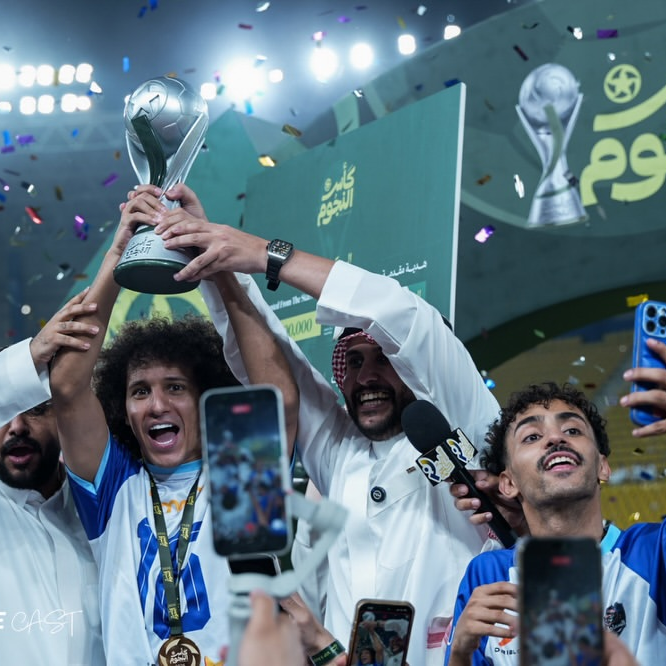
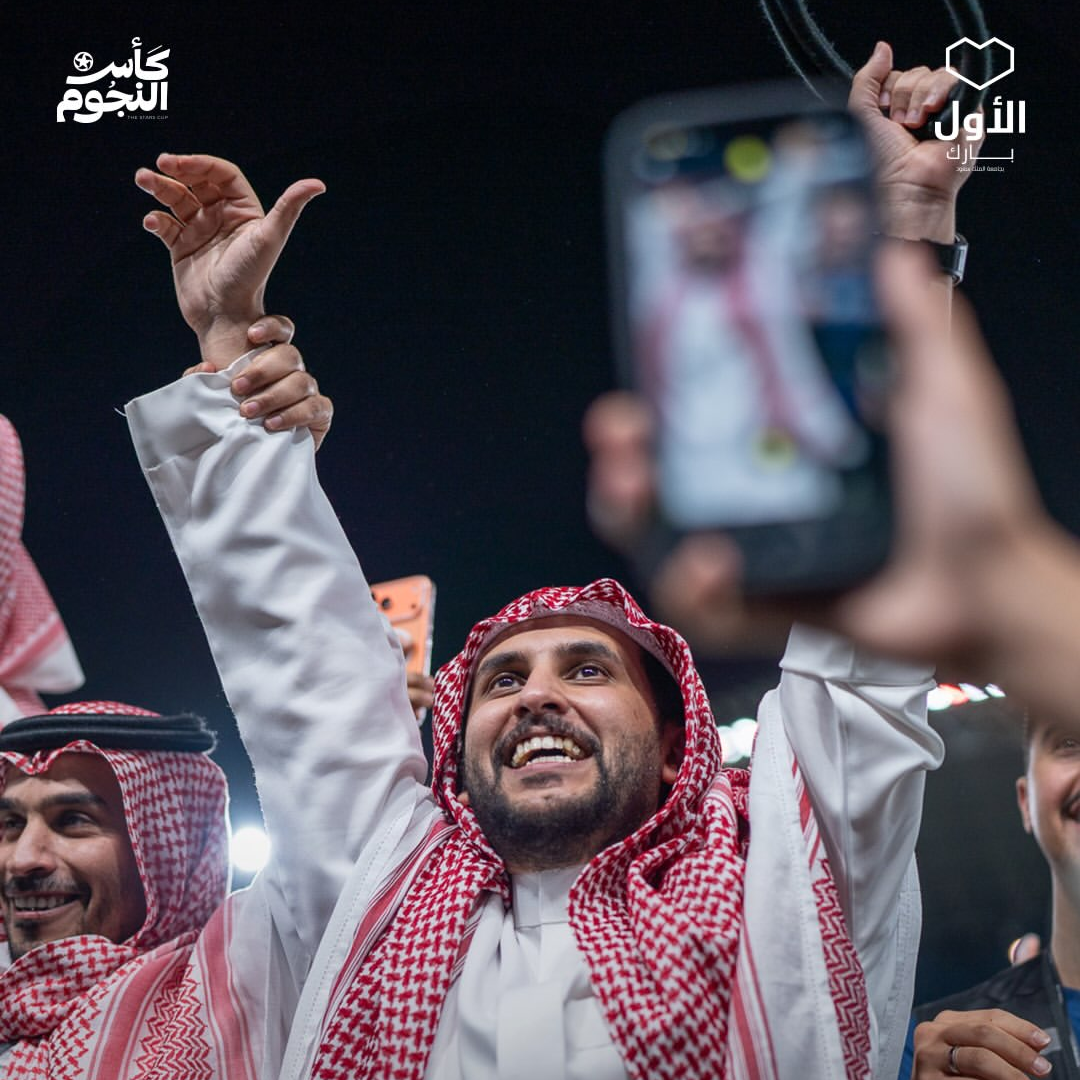
His public interests, meanwhile, continue to expand. In August 2026, Al-Sa'ateer, a popular Saudi celebrity football team led by Naif Hamdan, won the first edition of the Stars Cup, adding creator-led sports entertainment to a public identity already spanning history, horses, collecting, and culture. Yet expansion has not erased the original Naif. History remains the center.
A Modern Saudi Hakawati
There is something old inside Naif Hamdan's very modern career. Arab culture has always valued the person who could gather people around a story. The technology changed. The instinct did not. The majlis became Snapchat. The listening circle became millions of screens. Historical characters who might otherwise remain names on pages became people with tempers, mistakes, ambitions, victories, and strange decisions.
Naif's achievement is not simply that he talks about history. It is that he makes people want to know what happens next. And that matters in today's Saudi Arabia. The Kingdom's cultural transformation is not only about creating something new. It is also about finding new ways to understand what was already here: heritage, identity, knowledge, language, and memory.
Naif Hamdan's work sits naturally inside that movement. Not because he holds an official Vision 2030 role, but because his career reflects many of the same energies: youth opportunity, Arabic content, cultural confidence, creative careers, heritage, entertainment, and ambition.
Follow Naif Hamdan's journey on YouTube, Snapchat, TikTok and Instagram.


